
The Picky Eater Playbook: What Worked, What Backfired, and What I Wish I’d Known Sooner
I have raised a picky eater. Not the cute kind who “prefers pasta,” the kind whose accepted-foods list once fit on a sticky note with room left over, and whose dinner-table standoffs deserve their own documentary.
We’re on the other side of the worst of it now, well enough that I wrote a whole list of the fruits and veggies that survived the pickiest phase. This is the longer companion: the playbook of what worked, what absolutely backfired, and the reframes that changed everything.
The standard honest note first, and it matters more on this topic than any other I write about: I’m a mom sharing our experience, not a feeding specialist. Most picky eating is a normal, maddening phase.
But if your child’s list is shrinking instead of holding, if growth, energy, or weight worries you, or if mealtimes involve gagging, fear, or real distress, that’s a pediatrician conversation, not a blog-post situation. Going sooner beats going later.

The Reframe That Changed Everything
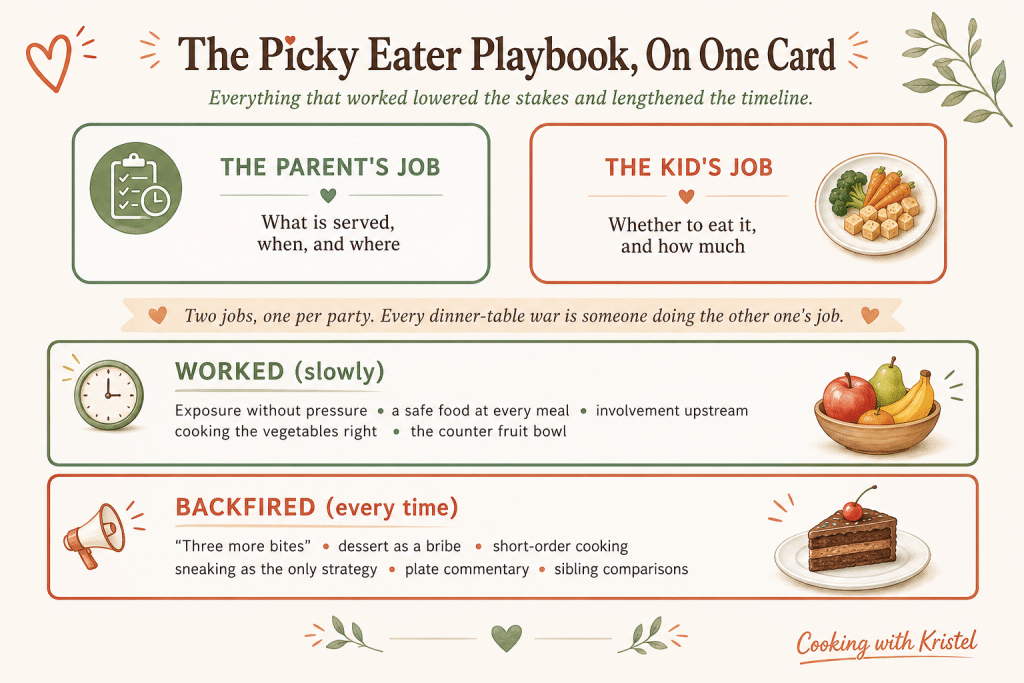
The single most useful idea I ever encountered on this subject, and it shows up across basically all mainstream feeding guidance, is a division of jobs: the parent decides what food is served, when, and where; the child decides whether to eat it and how much. That’s it. Two jobs, one per party, no overlap.
It sounds almost too simple until you notice how much dinner-table warfare is one party doing the other’s job. Every “three more bites” is me doing her job. Every separate kid-meal cooked on demand is her doing mine.
When we actually split the jobs and stayed in our lanes, the fights lost their fuel, because there was nothing left to fight about. I put the food out, she decided about it, and dinner stopped being a negotiation with a hostage.
Staying in my lane was, I’ll be honest, the hardest parenting discipline I’ve practiced. Watching a kid eat two rolls and ignore everything else while saying nothing is a workout. It also worked, slowly, which is the theme of this entire playbook: everything that worked, worked slowly.
What Actually Worked (The Slow Wins)
Exposure without pressure, on a comically long timeline. New and rejected foods kept showing up on the table in small amounts, next to guaranteed-eaten foods, with zero commentary. The general guidance describes ten to fifteen exposures; I would describe it as approximately one geological era.
The lunchbox turned out to be an even better venue than the dinner table for this. No audience, no standoff, just a quiet repeated introduction, which is the new-foods-ride-shotgun rule from our school lunch system.
The safe-food guarantee. Every meal included at least one thing she reliably ate, always. This isn’t catering, it’s insurance: a kid who knows she won’t leave the table hungry has no survival stake in the standoff, and a calm kid tries things a cornered kid never will.
Involvement upstream of the plate. Kids eat what they had a hand in embarrassingly more often. Choosing between two vegetables at the store, washing the produce during the get-home prep session, stirring, sprinkling, assembling their own from a build-it spread: every step of involvement bought a bump in willingness.
Self-assembly was the biggest lever of all, which is why taco night and build-your-own anything remain undefeated here.
Fixing the food, not just the kid. Some of the pickiness was, in retrospect, a fair review. The vegetables got dramatically more accepted when I learned to cook them properly: roasted instead of boiled gray, seasoned like food for humans.
That was the whole journey of the vegetables I finally learned to cook right and the roast-everything doctrine from the roast-instead-of-steam list. Method changes alone rehabilitated several former enemies, per the vegetables that taste completely different depending on how you cook them.
Environment over persuasion. The counter fruit bowl at kid height did more than a hundred lectures, the entire thesis of the fruits I keep on the counter so kids grab them instead of snacks: change what’s easy, not what’s allowed. Paired with keeping her from arriving at dinner starving (a decent afternoon snack makes a braver dinner guest), the environment did work persuasion never could.

What Backfired (Every Single Time)
| What I tried | What actually happened |
|---|---|
| “Just three bites” rules | Turned tasting into a toll; bites got counted, chewed grimly, and resented, and the food got a grudge attached |
| Dessert as a bribe | Taught, with impressive efficiency, that vegetables are the bad thing you endure and sweets are the prize |
| Short-order cooking on demand | Instant peace, compounding cost: the accepted list stopped needing to grow, so it didn’t |
| Sneaking as the ONLY strategy | Hidden veggies fed her body (and I still use the sneaky arsenal for nutrition), but sneaking alone taught nothing; visible exposure had to run alongside it |
| Praise for eating, commentary on not | Any audience reaction, positive or negative, raised the stakes; the table got calmer when plates stopped being performances |
| Comparing to sibling appetites | Instant resentment, zero broccoli. Retired after one outing |
The pattern across the whole table: pressure in any costume, bribes, rules, praise, sneaking-as-substitute, made things worse, and everything that worked was some form of lowering the stakes and lengthening the timeline.

The Scripts That Lowered the Temperature
Because staying in your lane is easy to endorse and hard to perform at 6:15pm, here are the actual sentences that replaced the old standoffs in this house, imperfectly but consistently:
| Instead of | We say | Why it works |
|---|---|---|
| “Just try three bites” | “You don’t have to eat it. It’s there if you want it” | Removes the toll booth; tasting becomes hers to choose |
| “You loved this last week!” | Nothing. Genuinely nothing | Plate commentary raises stakes in every direction |
| “No dessert until…” | Dessert isn’t tied to dinner at all here | Untangling the two ended the hierarchy of foods |
| “You’re being so picky” | “Not your thing tonight? No problem” | Labels stick; kids grow into the reviews they’re given |
| “One bite for Mommy?” | “Want to help me sprinkle the cheese?” | Involvement invites; pleading pressures |
| At a refusal | “Okay.” (and the meal moves on) | The most powerful script on the list is the shortest |
The scripts share one engine: they make refusal boring. A refusal that produces no reaction, no negotiation, and no consequence is just information, and a kid with nothing to push against eventually stops pushing and starts, very occasionally, at their own pace, tasting.
The table got quieter about two weeks in. Quieter tables, it turns out, are where the actual eating happens.

The Long Game, Honestly
Progress looked like nothing for months at a time. Then a rejected food would get eaten at a friend’s house like it had never been a war crime, and the list would grow by one. That’s the actual shape of it: not a breakthrough, a drift.
Three years of drift later, the sticky note is a full page and dinner is boring in the best way. The former hunger-striker recently requested seconds of a soup with visible mushrooms. The event received no commentary at the table, and an enormous silent celebration behind the kitchen door.
What Everyone's Making
27 Vegetables That Taste Better the Day After You Cook Them →
If you’re in the sticky-note phase right now: the standoffs aren’t a referendum on your cooking or your parenting, the timeline is longer than any blog post implies, and boring, pressure-free repetition remains undefeated.
Keep the safe food on the table, keep your lane, and keep the long game. It’s slower than every trick, and it’s the only thing here I’d bet on twice.
Keep reading: 25 Fruits and Veggies That Survived My Pickiest Eater Phase is the field-tested acceptance list, and the gentle-ramp plant-based guide runs this same no-pressure philosophy at the whole-family scale.