
The School Morning Machine: How We Went From Daily Chaos to Out-the-Door in 40 Minutes
There was a stretch, and the veterans of it still speak of it in hushed tones in this house, when our school mornings were forty-five minutes of raised voices, one lost shoe with supernatural powers of disappearance, and me arriving at drop-off feeling like I’d already worked a full shift.
What fixed it wasn’t a pretty printable or anyone becoming a morning person. It was accepting one unflattering truth and building a machine around it: nothing important can be decided in the morning, because morning is when this family is at its collective worst.
So the machine’s entire design principle is this: the morning executes, the night before decides. Here’s the whole system, including the parts that failed first.
The Night-Before Shift (Where the Morning Is Actually Won)
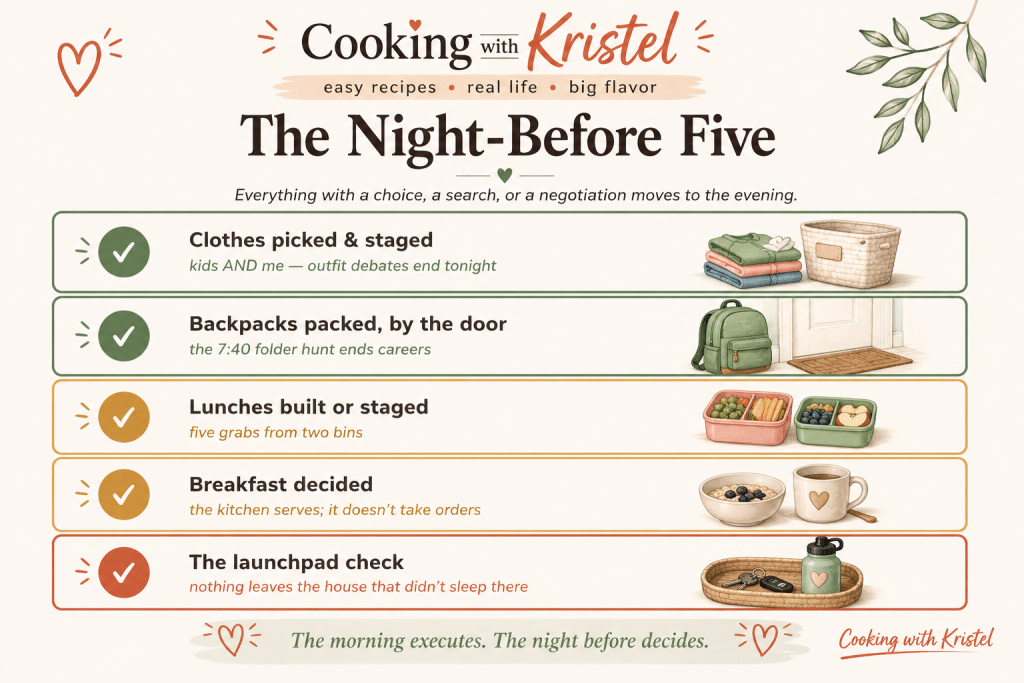
Everything that involves a choice, a search, or a negotiation gets dragged backward into the evening, when everyone still has a functioning brain. Our night-before checklist lives on the fridge and has exactly five items, because six was too many:
| Done by bedtime | Why it can’t live in the morning |
|---|---|
| Clothes picked and staged (kids AND me) | Outfit debates are the #1 morning time-eater in recorded history |
| Backpacks packed, by the door | The 7:40 folder hunt ends careers |
| Lunches built or staged | More on this below; it’s half the machine |
| Breakfast decided and prepped-ish | “What do you want” is a decision; mornings don’t do decisions |
| The launchpad check | Shoes, jackets, signed things, one spot by the door |
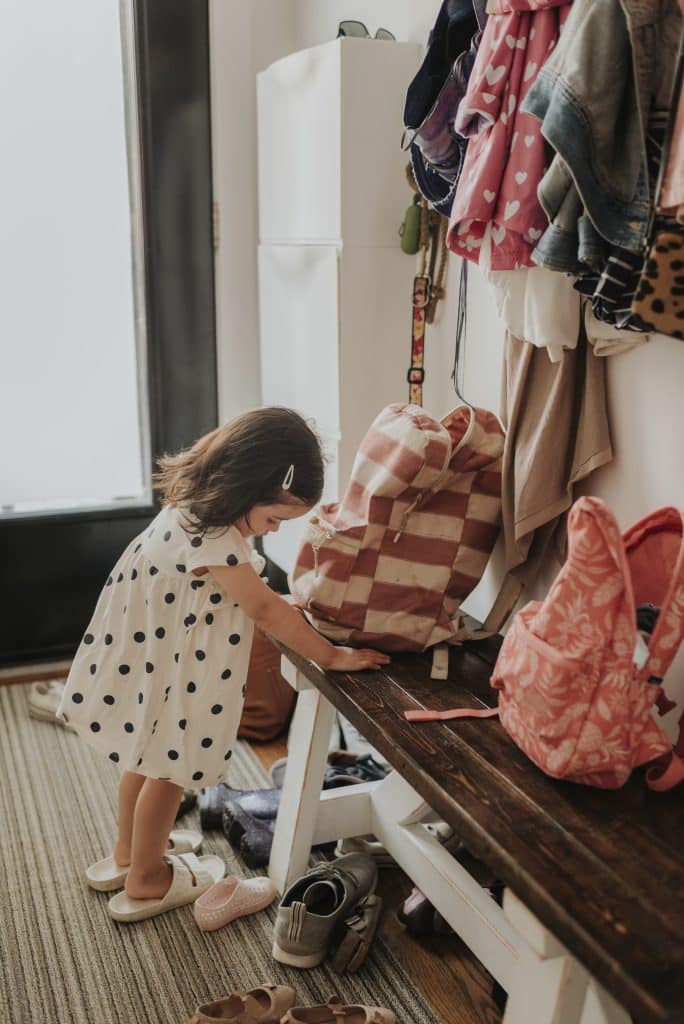
The launchpad deserves a sentence: it’s a bench and hooks by the door, and its rule is that nothing leaves the house that didn’t sleep there. The shoe with supernatural powers lost them the week the launchpad arrived, because the launchpad is boring, and lost shoes require adventure.
Lunches are the heaviest lift, so they got their own assembly-line treatment: components prepped once on Sunday, assembled in minutes each evening, and the prepped-the-second-I-get-home produce plus the veggies that make great leftover lunches straight from the fridge do most of the actual work. Half our lunches are Sunday’s cooking in a lunchbox.
The Morning Itself: A Boring, Beautiful Sequence
With decisions banished, the morning becomes a fixed sequence run in the same order every single day. Ours, timed honestly:
| Minutes | What’s happening | The rule that makes it work |
|---|---|---|
| 0-10 | Adults up first, ten minutes before kids | The single biggest upgrade on this table |
| 10-15 | Kids up, straight into staged clothes | Clothes on BEFORE leaving the bedroom |
| 15-30 | Breakfast, already decided | Kitchen serves; it doesn’t take orders |
| 30-37 | Teeth, hair, the bathroom shuffle | Same order daily; kids run on rails |
| 37-40 | Launchpad grab, out | Nothing to find, because everything slept there |
Two of those rules earn expansion. Adults-first is the one I resisted longest and swear by hardest: ten minutes of vertical, caffeinated quiet before the day’s clients wake up changes the entire tone of the operation, and a parent who wakes up behind spends the whole morning at a sprint, which every kid in the house can feel. And clothes-before-leaving-the-bedroom kills the pajama drift, that mysterious force by which a child can remain 40% dressed for 25 minutes.
Breakfast runs on a weekly rhythm rather than daily creativity: the same five or six breakfasts on loose rotation, several of them make-ahead. Overnight oats, freezer pancakes from the freezer time machine, fruit that lives where kids grab it themselves per the counter fruit strategy, and the energy-snack lineup pinch-hitting on the truly compressed days.
Nobody has ever been harmed by a rotating breakfast menu. Several people in this house have been harmed by an open-ended one.

The Evening Shift, Timed Honestly
Since “just do it the night before” is where this advice usually ends and where most families’ attempts die, here’s what the evening shift actually costs when it’s running well:
| Evening slot | What happens | Real minutes |
|---|---|---|
| Right after dinner | Plates cleared, lunch assembly from the bins | 5-7 |
| Homework wrap-up | Backpack packed as the closing act of homework, not a separate event | 2 |
| Before screens/play | Tomorrow’s clothes staged, launchpad check | 4-5 |
| Kid bedtime routine | Nothing; the work is already done | 0 |
| After kids are down | Breakfast staging, my own clothes, coffee prepped | 5 |
Call it fifteen to twenty minutes, spread across an evening in slots so small none of them feels like a task. That’s the entire trade: fifteen relaxed evening minutes buys back a morning that used to burn forty-five stressful ones, and the exchange rate is the whole reason the machine holds.
The anchoring matters as much as the timing; each item rides the end of something already happening (dinner, homework, bedtime), which is why it happens without a chart, the same anchor principle that runs our whole chore system.
Two seasonal notes. Summer relaxes the machine but doesn’t retire it; camp days and activity days run the same sequence with later clocks, because rebuilding the habit every September from zero is how we lost two previous Septembers. And the first two weeks of any school year run the sequence with training wheels: everything staged extra-early, timers visible, standards gentle. The machine is muscle memory, and muscle memory takes about ten school days to come back.

What Failed First (So You Can Skip Our Mistakes)
In the interest of full disclosure, the machine’s junkyard: the beautiful color-coded morning chart (admired for a week, invisible by week three; charts don’t run mornings, sequences do). Waking kids earlier to “add buffer” (buffer gets absorbed by slower moving; the fix is fewer tasks, not more minutes).
Screens before school “just while eating” (a ten-minute breakfast became thirty; screens moved to after-school and the morning got fifteen minutes back, and I’ll accept my unpopularity award at the door).
And my personal failure, doing the kids’ tasks for them to save time, which saves four minutes today and costs the whole system, because a machine only runs if the kids run their own stations, badly at first, then fine, then automatically.

Adjusting for Actual Children
Every kid runs the sequence differently, and pretending otherwise is how systems die. Our slow-starter gets woken ten minutes before the other and does the sequence at three-quarter speed to the same finish line. The one who negotiates got the negotiations moved to evening, where there’s time to lose them. Little kids run the sequence with a parent shadowing; bigger kids run it alone with spot checks.
And everyone, regardless of age, works for the one incentive we’ve found sustainable: the minutes between finishing the sequence and leaving belong entirely to them. Free time as the finish-line prize turns the sequence into a race they’re running for themselves, which beats every sticker economy we ever attempted.
What Everyone's Making
25 Fruits and Veggies That Make Vegan Cooking Cheaper Than You’d Think →

The Honest Payoff
The machine didn’t make us a serene family; it made us a family whose worst hour got boring. Mornings now run about forty minutes, raised voices are rare enough to be newsworthy, and the day starts without anyone, adult or child, feeling like they already lost.
A few mom life hacks that actually save time contributed spare parts to this machine, but the engine is just the one principle, applied without mercy: decide at night, execute in the morning, and let the morning be as dumb as it wants to be. It wants to be very dumb. Design for that, and it finally works.
Keep reading: the Sunday meal planning system is this same philosophy applied to dinner, and 21 Fruits and Veggies I Prep the Second I Get Home is the prep habit feeding both machines.