

Chores That Actually Stick: What Kids Can Really Do at Every Age (From Someone Who Made Every Chart)
I have made every chore chart. The magnetic one, the popsicle-stick jar, the app with avatars, the laminated masterpiece that took longer to design than the chores took to do. They all worked for eleven days.
What finally stuck wasn’t a chart at all: it was matching chores to what kids can genuinely do at each age, attaching them to anchors that already exist in the day, and lowering my standards to “done by a child,” which is a real standard and the one the whole system runs on.
This is my honest map of what worked at each stage, what every chart got wrong, and the handful of rules that turned chores from a nagging economy into just how our house runs. Usual disclaimer: these are one family’s ranges, kids vary enormously, and you know yours.

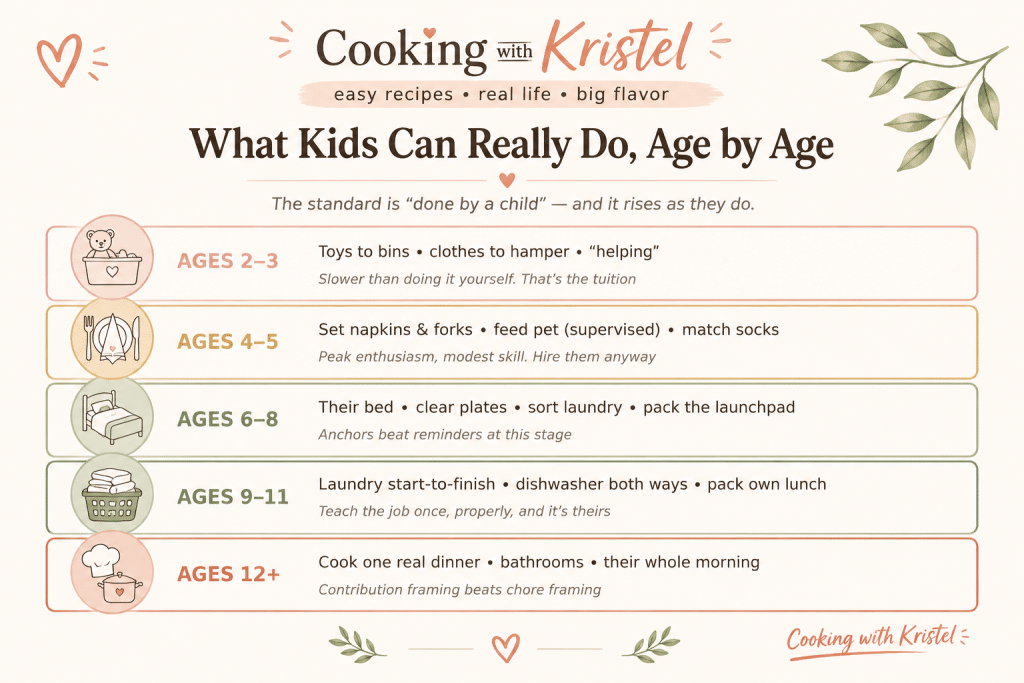
The Age Map (Realistic Edition)
The internet’s age-chore lists always read like they were written about hypothetical children. Here’s mine, calibrated to actual kids I have personally met:
| Age range | Genuinely doable | The realistic catch |
|---|---|---|
| 2-3 | Toys into a bin, clothes to a hamper, “helping” wipe | It’s slower than doing it yourself. That’s the tuition |
| 4-5 | Setting napkins and forks, feeding a pet with supervision, matching socks, watering plants | Enthusiasm is at lifetime peak; skill is not. Hire them anyway |
| 6-8 | Making their bed (a child’s version), clearing their plate, sorting laundry, emptying small trash cans, packing the launchpad | The nagging temptation peaks here. Anchors beat reminders |
| 9-11 | Real laundry start-to-finish, dishwasher both directions, packing their own lunch, simple vacuum routes | Quality plateaus until you teach the job once, properly |
| 12+ | Cooking one real dinner, bathrooms, lawn-adjacent work, their own morning entirely | The negotiation era. Contribution framing beats chore framing |
The pattern across every row: kids can do more than the charts say and less well than adults want, and both halves of that sentence have to be okay or the system dies. A six-year-old’s made bed looks like a six-year-old made it. Remaking it behind them is the single fastest way to teach a child that their work doesn’t count.
Anchors, Not Charts
Here’s the mechanical secret that outlasted every chart: chores attached to existing moments in the day get done, and chores attached to a chart get negotiated. Nothing in our house is scheduled “daily” anymore; everything is attached.
- Plates get cleared when dinner ends, not at 7pm. The launchpad gets packed when homework finishes.
- Laundry goes down when the hamper lid won’t close, a gloriously self-enforcing trigger.
- The pet gets fed before the feeder eats breakfast, which a certain dog in this house enforces better than I ever did.
Anchoring is why the chart era kept failing: a chart is a second system that needs its own maintenance, checking, and enforcement, and the enforcer was always me. An anchor rides a moment that was happening anyway.
The chart’s only surviving descendant here is a simple list on the fridge of who owns what this month, for reference, not for checkboxes.

Teach the Job Once, Properly
The step I skipped for years, and the reason kid-chores used to create more work than they saved: every job gets one real training session. Not “go clean your room,” which to a child is a wall of undifferentiated chaos, but the job broken into its actual steps, done together twice, then done by them with me nearby, then theirs.
Ten minutes of teaching buys years of a job actually done, and it’s the difference between delegating and just relocating my frustration.
The kitchen jobs pay this back fastest. A nine-year-old taught the dishwasher properly is a daily fifteen minutes returned to my life forever, and a twelve-year-old who owns one dinner a week, even a simple one off the one-pan dinner lineup or a quesadilla night, is learning the thing the whole chore project was secretly about.
Mine started with washing the produce from the weekly prep session, graduated to assembling leftover lunches, and the older one now runs a soup night with supervision that gets lighter every month.

Ownership Beats Rotation (Mostly)
A structural question every family hits: do chores rotate between kids or belong to someone? After running both, my answer is ownership with seasonal trades. Owned jobs build actual skill and end the “it’s not my turn” litigation entirely, since the dishwasher simply has a manager and everyone knows who.
The cost of ownership is staleness and the occasional fairness audit, so twice a year, at natural season breaks, jobs go up for trade in a fifteen-minute family swap meet. Trades are voluntary, deals are honored until the next window, and the kids negotiate harder than anything I’ve witnessed in professional life.
The one place rotation survives here is the jobs nobody would ever claim, the true grim duty roster (the trash cans, the mystery containers at fridge-cleanout), which rotate weekly on a strict schedule precisely because ownership of misery breeds resentment while shared misery breeds solidarity, or at least shared complaining, which in a family is close enough.
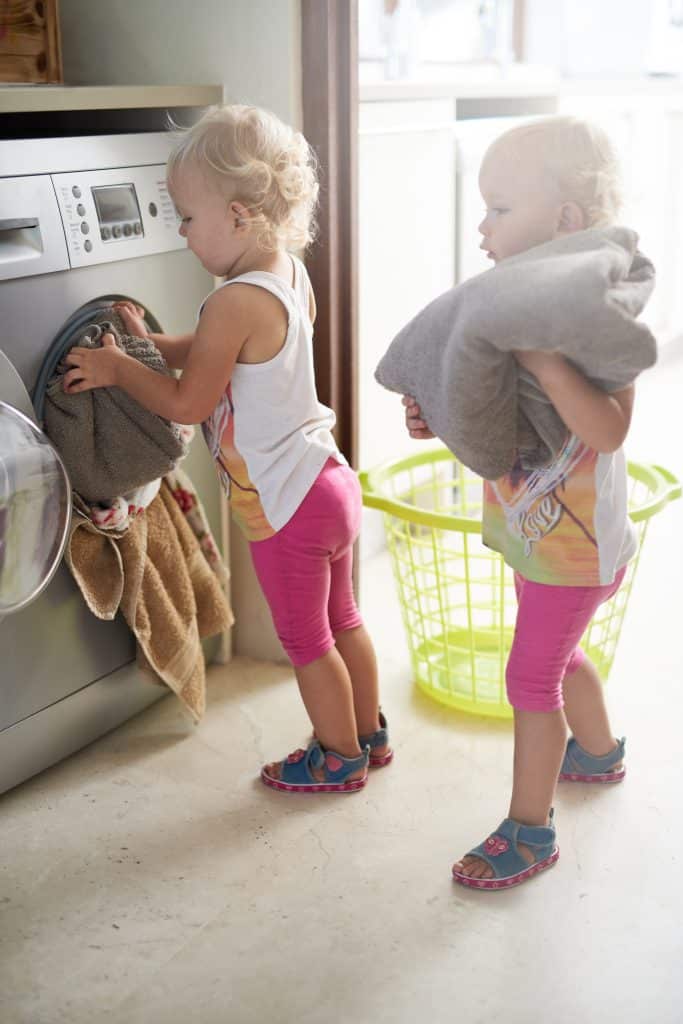
A companion rule that took me too long to learn: pair every job with its whole loop. The laundry job isn’t “bring it down,” it’s hamper to washer to dryer to delivered, because half-loops create orphan work that silently reverts to a parent, and orphan work is how a chore system turns back into a parent doing chores with extra steps.
Closed loops are also where the pride lives; a kid who runs laundry start to finish owns a result, and results are what turn “I have to” into “I handle that.”

The Allowance Question (Answered Sideways)
Everyone asks whether chores should be paid, and I’ll give you our answer while being clear it’s a parenting choice, not advice, and certainly not financial guidance: in this house, the base chores aren’t paid, because they’re membership, not employment. Everyone who lives here helps run here.
What we do keep is a short list of genuinely optional extra jobs that can be claimed for a little money when a kid is saving toward something, which keeps earning available without turning “clear your plate” into a wage negotiation.
Families run every version of this, paid, unpaid, hybrid, and I’ve seen all three work; the only version I’ve watched fail consistently is the one where payment gets invented mid-argument as leverage. Whatever your system, decide it calmly on a Tuesday, not at the sink during a standoff.
The Rules That Keep the Peace
The short list that survived years of trial and error.
- Standards scale to the worker: done-by-a-child is the standard for a child, and it rises as they do.
- No rescue redos: imperfect work stands, feedback comes as teaching next time, not correction this time.
- Consequences are natural where possible: the laundry not brought down is the jersey not clean for Saturday, which teaches more in one weekend than a month of reminders.
- The load is visible: kids do more willingly when the family’s whole workload is out loud, because “everyone’s doing their part” is checkable, and kids are auditors.
- And seasons change: sports seasons, exam weeks, and rough patches earn temporary lighter duty, announced, not snuck, because the system bending on purpose is what keeps it from breaking.
None of it made my children fold towels beautifully. All of it made this house a place where the work of living here is shared, mostly without drama, by people whose towel-folding is improving on a schedule I’ve made peace with. That was always the actual chart.
Keep reading: the school morning machine is the sibling system, where several of these anchors live, and 15 Mom Life Hacks That Actually Save Time has the shortcuts that keep the adult half of the workload honest.